Most cannabis products don’t get discounted because they’re bad or simply a slow mover. They get discounted because the data behind them isn’t effective before they even hit the shelf.
Wrong category. Missing fields. Broken COA link. Incomplete menu data.
The flower is fine. The vape is fine. But the product becomes harder to receive, to understand, and to sell. Eventually it gets marked down. In these all-too-often cases, the product didn’t fail. The data did. And in cannabis retail, most data failures start long before a product reaches the shelf.
The hidden cost of insufficient data
The cannabis industry has remained steadily focused on product quality, compliance, and customer experience. Those are the right priorities. But products don’t sell on quality alone — they also depend on accurate, consistent data.
Cannabis operators are racing against the clock to sell inventory before it ages into markdowns, promotions, or waste. Every day a product sits on the shelf reduces its chance of selling at full price. When data breaks upstream, that window shrinks even further.
Incomplete menu data, broken COA links, and inconsistent product information make products harder to discover, recommend, and trust.
Retailers don’t just discount bad products. They discount bad data.
Where things actually go wrong
A lot can go wrong during packaging and labeling. Optional fields in Metrc may get treated as an afterthought, but operationally, many of them are anything but. A missing Cannabinoid, no terpenes, an incomplete strain description: none of these prevent a label from printing, but all of them cause problems at intake, on menus, and at the register.
Compliance data is typically created once, during compliance setup and packaging, and then interpreted multiple times: at intake, in the POS, on the digital menu, and at the point of customer interaction.
One system calls a product “Hybrid Flower.” Another calls it “Flower – Hybrid.” A third calls it simply “Flower.” To a digital menu or filtering algorithm, those are different products.
Data is created once, but interpreted multiple times. Every interpretation introduces new challenges.
The POS reality
POS systems don’t create bad data — they expose it.
Some POS systems pull product information from Metrc and Retail ID cleanly. Others require inventory managers to manually enter fields that could otherwise be auto-populated, allow category overrides, or display incomplete information without warning.
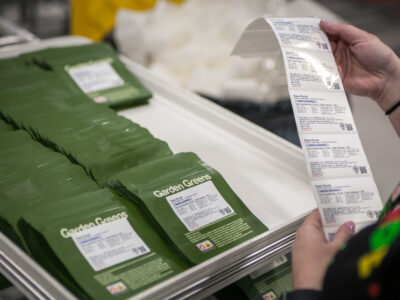
To compensate, dispensary staff often print secondary stickers, recreate product information, or manually correct inventory just to get products onto the sales floor.
Retail ID integrates directly with major POS providers as well as ERP systems. But even the best integration can’t correct incomplete or inconsistent source data. It simply makes those issues visible sooner.
Operational impacts
Data problems don’t stay in the back office. They show up in operations, sales, and ultimately revenue.
When products can’t be received cleanly, staff spend time correcting fields, printing new labels, and manually recreating information. Across hundreds or thousands of products, those small inefficiencies quickly compound.
The impact extends beyond intake. Incomplete or inconsistent product data can prevent products from appearing in filtered searches, category pages, or recommendation results. In some digital menu configurations, products may not appear at all until the underlying data is corrected.
Missing images and incomplete product information also make products less likely to be selected by shoppers browsing online menus. And when budtenders can’t immediately access accurate product details, potency, terpene profiles, or COA information, they spend more time answering routine questions and less time helping customers make purchasing decisions.
Products that sit longer age into the discount window. They aren’t always discounted because demand wasn’t there. They’re discounted because incomplete or inconsistent data made them harder to discover, recommend, and sell while they still had the opportunity to command full price.
Retail ID as a data control layer
Retail ID is a single source of truth for every legal finished good product and supports more efficient labeling.
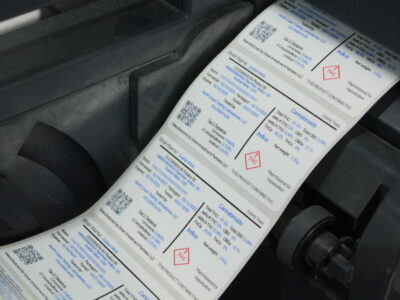
It is also a data control layer, helping deliver structure at the moment data is most likely to go wrong: packaging, labeling, and intake. The labeling output, a serialized QR code linked to verified Metrc package data and COA, is the result of that structure.
When data hasn’t been mapped correctly in Metrc, Retail ID won’t let a label move forward. Labels cannot be completed without required mappings. No label means the problem gets caught at packaging, not after it’s already sitting on a shelf two transfers down the supply chain.
That’s a fundamentally different kind of value. Not cleaner labels or relabeling requirements after the fact.
Disclaimer: Retail ID is available in most Metrc states. State-specific product packaging and labeling rules and regulations vary across jurisdictions.
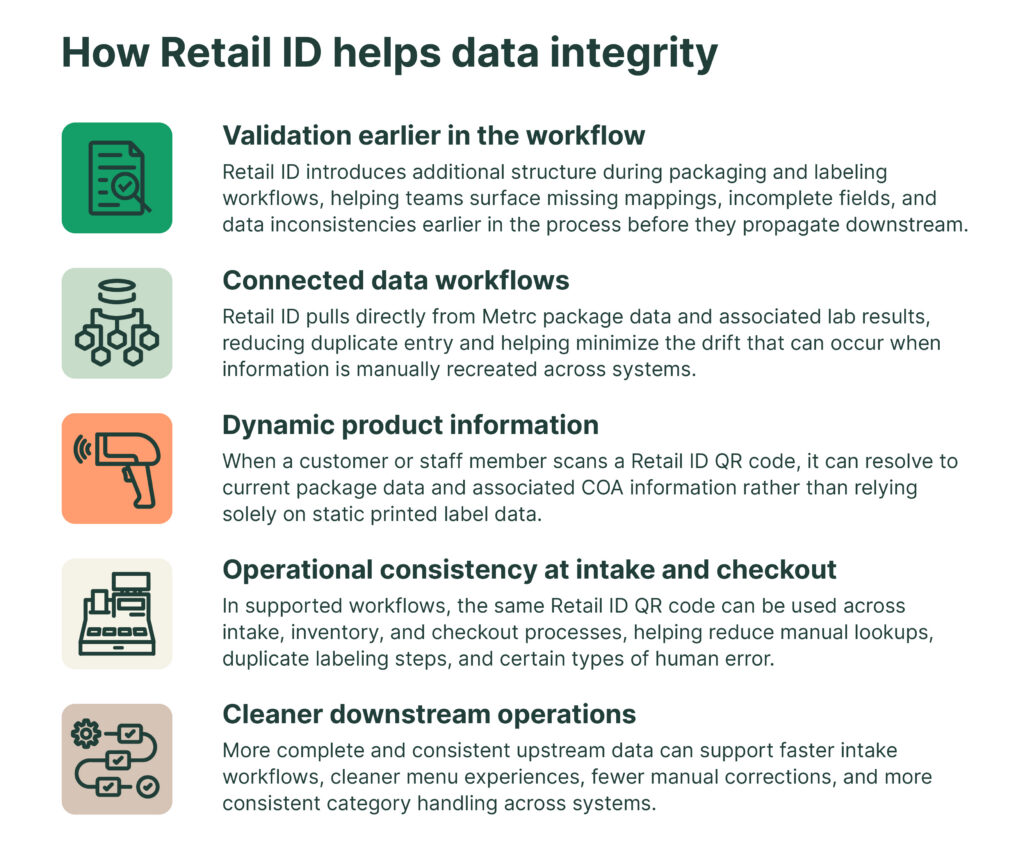
How Retail ID helps reduce data integrity issues before they spread
Validation earlier in the workflow: Retail ID introduces additional structure during packaging and labeling workflows, helping teams surface missing mappings, incomplete fields, and data inconsistencies earlier in the process before they propagate downstream.
Connected data workflows: Retail ID pulls directly from Metrc package data and associated lab results, reducing duplicate entry and helping minimize the drift that can occur when information is manually recreated across systems.
Dynamic product information: When a customer or staff member scans a Retail ID QR code, it can resolve to current package data and associated COA information rather than relying solely on static printed label data.
Operational consistency at intake and checkout: In supported workflows, the same Retail ID QR code can be used across intake, inventory, and checkout processes, helping reduce manual lookups, duplicate labeling steps, and certain types of human error.
Cleaner downstream operations: More complete and consistent upstream data can support faster intake workflows, cleaner menu experiences, fewer manual corrections, and more consistent category handling across systems.
Back to that product on the shelf
With Retail ID in place, many of those issues become visible earlier in the workflow — during packaging, intake, or inventory validation instead of after the product reaches the shelf.
Missing fields, mismatched categories, or incomplete product data can be identified before inventory reaches the sales floor, helping reduce downstream corrections, duplicate labeling, and operational friction at checkout.
The result is more consistent product data, smoother intake and menu workflows, and fewer products becoming harder to sell because the information behind them broke somewhere along the way.
Better product data drives better retail performance
Cannabis operators increasingly depend on product data to power intake, menus, compliance, and customer trust, but consistency can break down as that data moves across systems, workflows, and retail environments.
Products are getting better. Compliance requirements are getting clearer. But operational friction still emerges when product information is incomplete, inconsistently mapped, manually recreated, or interpreted differently across the supply chain.
As cannabis retail becomes more digital, data quality increasingly affects discoverability, intake speed, menu visibility, and customer trust. Products are no longer competing solely on quality or price. Operators are always racing the “expiration date” to sell 100% of a product; finding these gaps earlier helps reduce product destruction/waste and directly increases revenue.
Retail ID doesn’t simply add another label; it helps customers streamline their purchasing decisions and retail operators reduce their workflows. By connecting labeling workflows directly to Metrc package and test data, it helps reduce inconsistencies earlier in the process and supports more consistent product information across intake, menus, and retail workflows.
The products that move most efficiently aren’t always just the best products. They’re often the products backed by data that stays consistent, accessible, and easy to trust from packaging to purchase.