Giving QR Codes a Purpose, Not Just a Number
QR codes are everywhere in cannabis packaging now. But too often, they simply launch a dead-end: a string of digits (the Metrc package unique identifier, or UID) or an internal tracking link. In one telling moment, a dispensary manager told us a customer scanned a product’s QR code and saw “nothing but a number.” That’s a waste. If you’re already printing a QR code on each package, it should do much more than meet the bare minimum.
A scan should answer real questions: Is this product legal? Has it been lab-tested? What’s the potency or strain profile?
Instead, most QR codes were designed for regulators or budtenders, not consumers. They check a box but fail the transparency test. A UID-only QR is essentially a disguised barcode — useful for internal workflows, meaningless to the shopper.
The result? Missed trust, no connection to lab data, and more work downstream. As one grower put it, QR codes can feel like “throwaway” labels if they only resolve to a number. When it already has prime real estate on your package, it should become a consumer trust moment and a retailer efficiency tool — not just a regulatory afterthought.
Why “UID-only” QR codes are outdated
Historically, cannabis QR codes served one of two purposes: they either linked to a brand page for marketing, or they encoded a package ID so budtenders could scan inventory into a POS system. Rarely did a single QR code combine regulatory data, lab results, and brand context — or function like a true UPC that works across compliance, retail operations, and the consumer experience.

Caption: A QR code with only a package ID leads to a blank search result—providing no product context, lab results, or consumer transparency.
That approach worked — for a narrow moment in time. But it effectively froze QR codes in a single purpose: package intake OR brand information OR access to a Certificate of Analysis (COA). As cannabis retail matured, expectations changed. Consumers began scanning packages. Regulators began expecting public access to testing data. Retailers began demanding faster, cleaner item-level data flow. A QR code that functions only as a packaged ID no longer reflects how products move, how information is accessed, or how compliance is enforced today — creating avoidable gaps downstream.
A QR code used only as an internal tag ignores real opportunities (and introduces risk).
The consequences of UID-only QR codes
Consider the consequences:
- Lost trust moments. A scan that shows only a UID number leaves consumers in the dark. By contrast, showing test results and ingredient info reassures people. Studies show transparency builds confidence — packages with scan-friendly lab reports give consumers credible proof of safety and potency. A UID-only scan does the opposite: it erodes trust with data that an end consumer can’t see.
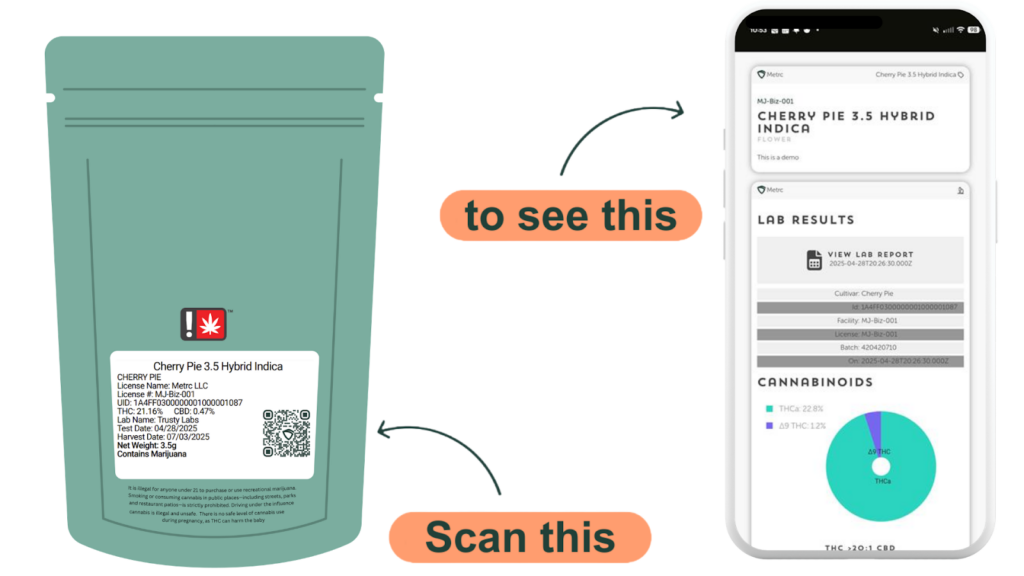
- No COA or test access. Modern shoppers expect to see a COA when they scan. With Metrc’s Retail ID, however, each scan leads right to the COA and potency breakdown. Retail ID links a QR code directly to its COA and lab results, eliminating paper for digitally traceable product info. A bare UID has none of that built in.
- Extra retailer work. When a QR code points only to a brand page instead of encoding the package UID, it can’t be used as a scannable identifier at intake or checkout. Retailers then have to apply a separate barcode or UID label so the product can be scanned into the POS and reconciled with Metrc, creating extra labeling steps and manual handling. Instead of one scan serving compliance, inventory, and the consumer experience, staff are forced to manage multiple labels for the same item.
- Weakening compliance posture. Regulations are shifting under our feet. Many states now require that QR codes link to COAs or detailed product info. For example, some rules explicitly mandate that every cannabis product “provide a Certificate of Analysis via QR code or link”. Similarly, other regulators insist that any QR on packaging must send the user straight to that product’s COA. A UID-only scan won’t cut it. As rules tighten, companies with static QR codes will find themselves out of step.
- Zero brand story or education. A blank QR feels like a missed chance to talk about your product. UIDs give brands literally nothing to say — no terpene info, no usage tips, no marketing flair. Meanwhile, Retail ID landing pages can host rich content: strain origins, flavor profiles, usage guides, or outbound links to a brand’s website. By not leveraging that space, you cede a direct line to the customer.
Key takeaway: If a QR code does nothing more than mirror a barcode, it’s shortchanging customers and your brand.
What do modern consumers and regulators expect?
QR codes have become a digital handshake between brands and buyers — especially in cannabis, where lab tests are critical. Today’s consumers are savvy: many have grown used to scanning packages for info. In fact, QR code use has exploded.
What do they want to see? Key data points like THC/CBD potency, serving size, ingredients and test results. A bonus is everything on the COA: contaminant screening, nutrient values, and the terpene breakdown. Many smart-packaging initiatives now link QR codes to a digital product profile or COA. If your QR code points only to a Metrc UID, it won’t meet that expectation.
Regulators agree. Across many jurisdictions, new rules are putting transparency into law. Consumers also view transparency as a confidence booster. Surveys indicate a majority of shoppers appreciate companies that offer scan-enabled details on packaging. QR codes that reveal lab results and ingredient sources build trust.
UID vs. Retail ID: What’s the practical difference?
Let’s break down the two options side by side. In the table below and the bullets afterward, we’ll compare what a basic UID code delivers versus what a Metrc Retail ID code can do:
| Feature | UID only | Retail ID |
| Internal tracking | ✔️ | ✔️ |
| Consumer transparency | ❌ | ✔️ |
| COA/test access | ❌ | ✔️ |
| Retail intake efficiency | ❌ | ✔️ |
| Brand messaging opportunity | ❌ | ✔️ |
| One scan for all stakeholders | ❌ | ✔️ |
UID vs. Retail ID: The simple difference
Both UID-only codes and Retail ID are tied to Metrc and support supply-chain tracking. The difference is what happens when the package is scanned.
A UID-only QR code confirms a package exists.
A Retail ID scan confirms what’s in it, including test results.
Retail ID does not replace the UID or disrupt point of sale workflows. It builds on the same identifier and makes lab data, potency, and product details available at the moment of scan, turning a QR code from a compliance artifact into a trust signal.
Real-world scenarios: UID vs. Retail ID
Consumer scans the package
UID-only: Displays a tracking number with no product context.
Retail ID: Displays potency, lab results, and product details, confirming the product is legal, tested, and compliant.
Retail intake and receiving
UID-only: Supports intake but provides no additional information.
Retail ID: Uses the same identifier while adding product details and test data, reducing questions during receiving.
Brand audit or recall
UID-only: Requires logging into systems to trace lots and documentation.
Retail ID: Each scan links directly to the lot and COA, creating an immediate audit trail.
One scan should deliver clarity to consumers, efficiency to retailers, and traceability to regulators. Retail ID delivers on that promise. A lab manager reported that adopting Retail ID reduced label updates from weeks to minutes while improving consumer transparency.
Upgrading your QR code strategy is easier than you think
Switching from a plain UID code to a full Retail ID system doesn’t mean redesigning your whole package. It’s mostly a change in what your existing code does. Here’s a simple roadmap:
- Audit your current QR use. Print or scan your product labels to see where they point. If you only see a UID, that’s a sign to upgrade.
- Generate Retail ID codes via Metrc. Metrc can create a unique Retail ID QR code for each unit in a package.
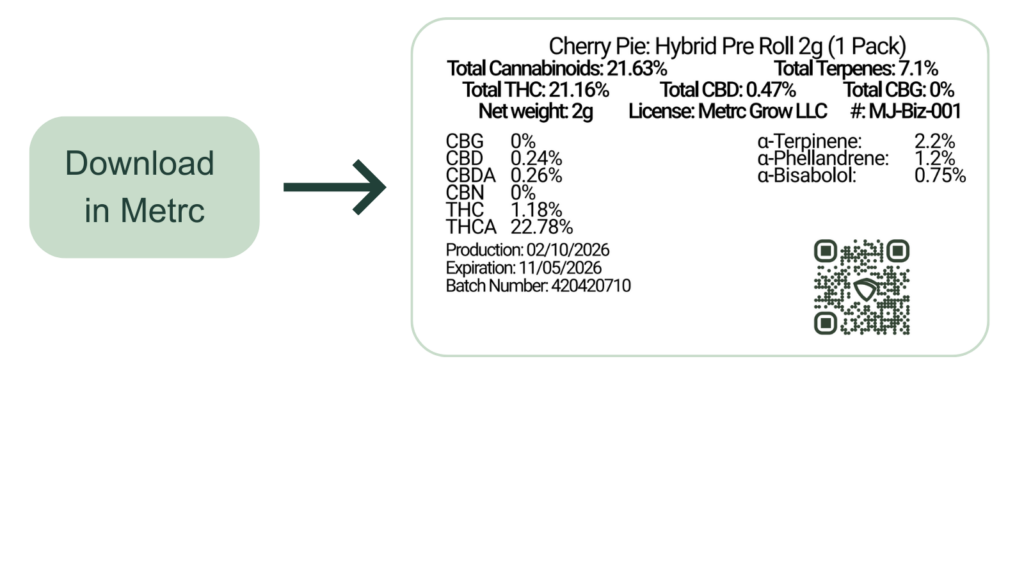
Caption: Retail IDs can be downloaded directly from Metrc to generate finished good labels with embedded product, brand, and testing information.
Feed those Retail ID codes into your label-printing workflow. Some operations simply export a PDF and use Adobe Acrobat. Others use a CSV of QR URLs from Metrc and apply them in their labeling platform.
Metrc has developed step-by-step guides for leveraging these recommended software tools:
- Integrate with printing software or ERP. Check out these partners for additional tools and workflows designed to make Retail ID implementation even easier:
| Integrator | Retail ID resources |
| Canix | Here |
| Distru + DistruLabels | Here |
| Dutchie | Here |
| Flourish | Here |
| Growflow | Here |
| Stashstock | Here |
| QRlogix | Here |
- Coordinate with your lab. If you’re moving to Retail ID, make sure your lab is testing panels that consumers want to see, including terpenes.
- Test your scan flows. Before printing packaging runs, scan some codes with a smartphone. You should see a mobile-friendly page with the COA and product info. You can verify your test data in the Metrc application.
- Print prominently. Put the QR code in a visible place (on the main label or lid). Avoid tiny, dark, or curved placements. Clear space around it improves scannability.
- Monitor and refine. Once live, occasionally test QR codes (especially after repackaging or lab updates). Keep an eye on any feedback from retailers or customers. Make sure the landing page stays up to date if you retest a batch.
The key insight? You’re not tearing up your labels; you’re just making your QR codes work smarter.
The bottom line: Your QR code is a trust moment
A QR code on a cannabis package is no longer just a regulatory or retailer checkbox — it’s a brand moment. Every time a consumer or store scans that square, you have a chance to deliver value. Retail ID transforms that moment into a safety check, a marketing touchpoint, and an efficiency hack all at once.
Retail ID unlocks:
- Consumer transparency
- Retail efficiency
- Regulatory alignment
- Brand storytelling
As Jordan Medeiros, COO of Organic Remedies (MD), told Metrc:
“Retail ID has been the best labeling system we’ve used. It’s incredibly flexible, responsive, and cannabis-specific. The added benefits for branding and customer support have been a pleasant surprise.”
To sum it up: A smarter QR code builds confidence, saves money, and makes your brand look good.
—
“For boutique brands, having a tool like Retail ID ensures compliance, reduces costs, and simplifies operations while also helping differentiate from competitors with better branding.”
Joyce Cenali
Chief Operating Officer
Sonoma Hills Farm
Key takeaways:
- A plain QR code pointing only to a Metrc UID builds no consumer trust or value.
- Modern regulations increasingly require QR-linked COAs and traceability.
- Retail ID QR codes provide COAs, potency, and product info instantly.
- Retailers benefit from one-scan intake and easier audits.
- Upgrading is straightforward with Metrc: Generate Retail ID codes, test them, and print them directly on packages or package labels.
- Think of your QR as a trust-building moment — use it to deliver real value.
Bottom line: Check what your current QR code does right now and compare it to a modern Retail ID scan to see the difference. Every package already has a square inch of QR — make it count.